
Supply Chain Roundup - Week 38-40 - 2023
Updated: Jul 13, 2024
Green Initiatives and Compliance
SNCF's Decarbonization Strategy
SNCF has ambitious plans for decarbonization, involving approximately 20,000 suppliers who provided over €13 billion in supplies and services in 2022, ranging from engineering works to industrial supplies and intellectual services. For the five core rail companies within SNCF, procurement accounts for 80% of greenhouse gas emissions, making supply chain decarbonization crucial for the overall business.
Over the next two years, SNCF will gradually introduce transparent and accessible carbon-based rating criteria to all tenders, using an internal carbon price of at least €100 per metric ton of CO2e. The carbon emissions from these purchases often stem from secondary and tertiary suppliers, making it essential to decarbonize the entire supply chain.
Feedback from top suppliers indicates progress, with 75% having measured at least part of their carbon footprint and over 50% adopting ambitious decarbonization targets.
Tech Industry's Decarbonization Efforts
Sustainability and decarbonization are increasingly prioritized by technology companies due to pressure from customers, shareholders, and regulators. Most tech companies are setting ambitious emission reduction goals, though only half report being on track to achieve them.
In technology, most emissions are Scope 3, resulting from upstream supply chains or downstream product use, which are harder to control than Scope 1 (operations) or Scope 2 (energy use) emissions. Companies are employing strategies like using more renewable energy in data centers, optimizing supply chains, and redesigning products to consume less energy.

Examples include Microsoft’s commitment to 100% renewable energy by 2025 and Apple’s Clean Energy Charging setting, which reduces downstream Scope 3 emissions. New business models, such as hardware-as-a-service, help extend product lifespans and reduce emissions. Companies are adopting a holistic perspective, integrating emission reduction into strategic planning, and facing increasing regulatory pressure to disclose and reduce emissions.

Sources:
Innovations in Digitalization
Escalating Cyberattacks in the Software Supply Chain
A recent report from Sonatype reveals that 2023 witnessed a dramatic increase in software supply chain cyberattacks, surpassing the total attacks from the previous three years combined. This year alone, there have been twice as many attacks, with Sonatype logging 245,032 malicious packages. Alarmingly, one in eight open-source software (OSS) downloads today pose known and avoidable risks.
Despite the prevalence of these threats, only 11% of OSS projects are actively maintained. The vast majority of vulnerabilities are avoidable, as demonstrated by the 2.1 billion OSS downloads with known vulnerabilities in 2023 that could have been mitigated with newer, patched versions. The extensive availability of insecure software significantly impacts supply chains, making them susceptible to back-door cyberattacks. A notable example is the MOVEit cyberattack, which compromised data from organizations such as PwC, Aon, BBC, British Airways, and many others.
Enhancing Supply Chain Resilience with Digital Twin Technology
As supply chain resilience becomes increasingly crucial, digital twin technology is emerging as a transformative solution. Lee Annecchino of Capgemini explains that a digital twin is a virtual replica of various assets, including warehouses, logistics, and inventory positions. Organizations can implement multiple layers of digital twins to represent both assets and their interactions with people.
A common data platform strategy is often needed but lacking, which can connect data across all digital twins through digital threads. Industry-specific standards and communities, such as the OPC Foundation, the Digital Twins Consortium, and Microsoft's Open Manufacturing Platform, are essential for achieving this integration. These platforms promote the awareness, adoption, and interoperability of digital twin technology.

A Capgemini report highlights the benefits of visualizing and addressing issues virtually before committing to solutions, making digital twin technology invaluable for industries like aerospace and defense. As a result, 73% of aerospace and defense organizations have long-term roadmaps for digital twin technology, with investments projected to increase by 40% annually, emphasizing the need for flexible supply chains.
Leveraging Generative AI for Supply Chain Optimization
Apparel company Hanesbrands is utilizing generative AI technology to optimize its supply chain. This intelligent tool helps answer complex supply chain questions and makes the information accessible to all HanesBrands associates. The Gen AI assistant, powered by OpsVeda, integrates with messaging tools such as Microsoft Teams, Slack, or WhatsApp, enabling users to gather information through natural language exchanges.
Hemant Ramaswami, VP of Global Supply Chain Planning at HanesBrands, describes the AI tool as pivotal for supply planning, PO prioritization, and inventory utilization, improving service to customers. Grace Foods Canada has also been using an initial supply chain tool to enhance tracking and customer service, with plans to implement new Gen AI features for faster access to critical information. This approach aims to boost productivity and embed a more data-driven, customer-centric strategy within the company's global ecosystem.
Combatting Digital Supply Chain Threats
Human Security has successfully disrupted a sophisticated digital supply chain threat originating from China, targeting Android devices. This campaign, known as Badbox, involves the Triada malware, which acts as a backdoor on various devices such as CTV boxes, smartphones, and tablets during the supply chain process in China. Badbox-infected devices can steal personally identifiable information (PII), establish residential proxy exit peers, and create fake messaging and email accounts, among other fraudulent activities.
Consumers cannot easily fix these infected devices, as the malware connects with a command-and-control server upon initial boot-up, even after restoring factory defaults. Human Security's investigation revealed that 80% of devices acquired from online retailers were infected with Badbox, highlighting the extensive circulation of these compromised products.
Integrating Supply Chain Solutions for Enhanced Transparency
Many organizations currently use siloed functional and technical systems to solve business problems but often lack traceability and transparency across the end-to-end value chain. Accenture’s SynOps for Supply Chain on AWS addresses these challenges by providing a fully integrated solution that enhances decision-making transparency and traceability.
Organizations aim to improve supply chain resilience amid disruptions while delivering relevant customer experiences and incorporating responsible business practices into decision-making. SynOps for Supply Chain on AWS allows teams to harness real-time data insights and a blend of human and machine talent, fostering a resilient, relevant, and responsible supply chain that drives profitability and growth.
This solution transforms supply chain operations and enhances collaboration and innovation within the organization and across ecosystem partners. SynOps for Supply Chain on AWS features four specific user interfaces: Supply Chain Leadership, Supply Chain Manager, Supply Chain Associate, and Administrator. It also includes pre-built integrations with Amazon services and best-in-class supply chain ecosystem tools such as SAP ERP, SO99+ for demand planning, Blue Yonder for planning and transportation management, and E2Open for ocean booking.
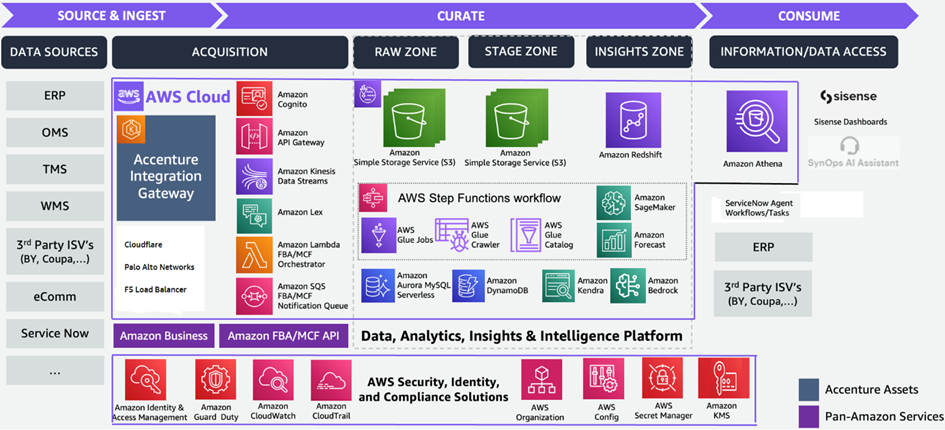
Designed from the ground up as a cloud-native, multi-tenant solution, SynOps leverages Accenture’s library of accelerators, providing organizations with a robust toolset for enhancing supply chain operations and resilience.
Sources:
Open source software 'increasing threat to supply chains' | Supply Chain Magazine (supplychaindigital.com)
Digital twins bring resilience and savings to supply chain | Supply Chain Magazine (supplychaindigital.com)
HanesBrands Leveraging Gen AI in Supply Chain Optimization Efforts | Consumer Goods Technology
China-based Supply Chain Cyberattacks Hit Thousands of Android Devices | MSSP Alert
How Accenture Reimagines Supply Chain Operations Using SynOps for Supply Chain on AWS | AWS Partner Network (APN) Blog (amazon.com)


Comments