
Supply Chain Roundup - Week 35-37 - 2023
Updated: May 19, 2024
Amazon Expands Its Reach Beyond Its Platform
Amazon's ambition extends beyond just making everyone shop on its platform. The company aims to be the backbone of retail infrastructure, even when shopping occurs elsewhere. On September 12th, Amazon unveiled "Supply Chain by Amazon," a suite of physical and online services enhanced with new features. This comprehensive solution manages products from the manufacturer to the shopper, significantly expanding to support non-Amazon sales channels. Previously, Amazon’s logistics and fulfillment services primarily supported Amazon sellers selling on Amazon.

"Supply Chain by Amazon" is structured into three segments. The first segment deals with importing goods from factories and local suppliers. The second offers warehousing solutions to store goods and supply them for sale on Amazon, other sales channels, and physical stores. The third focuses on fulfillment through Amazon’s FBA and other channels via MCF and Buy with Prime. Before this announcement, the warehousing solution (Amazon Warehousing Distribution) exclusively resupplied FBA, making this expansion a significant shift toward omnichannel capabilities.
This strategy isn't new for Amazon. The company has previously monetized its infrastructure with Amazon Web Services (AWS), a cloud computing platform initially created for its e-commerce site but now a major profit center. In Q2 2023, AWS generated $22.1 billion in sales, marking a 12% year-over-year increase. According to Wedbush analysts, Amazon is replicating the AWS strategy by expanding its fulfillment network’s availability. If "Supply Chain by Amazon" achieves similar success to AWS, it could become a significant revenue source for Amazon.
Sources:
Aerospace Industry Gears Up Amid Supply Chain Challenges
In its latest report, Roland Berger describes how and why Aerospace OEMs are preparing to increase production after several turbulent years. The question remains whether supply chains are robust enough to support this growth amid ongoing economic and political disruptions. Recent global crises, including the US-China trade war, the COVID-19 pandemic, and the Russian invasion of Ukraine, have severely impacted aerospace supply chains, causing widespread delays and missed deliveries in 2022 across various capital-intensive industries.
With a gradual return to stability, OEMs are ramping up production in 2023, eyeing growth in 2024 despite rising interest rates. There is considerable potential for improvement across all supply chain dimensions, especially transparency. To address these challenges, OEMs and suppliers need to adopt best practices and explore new supply chain strategies. Building more localized supply chains in regions like North America, Europe, China/APAC, and India could be a solution.
A key finding reveals that 62% of respondents still consider supply chain disruptions severe. Those less affected typically benefit from local sourcing and ample buffer stock, underscoring the need for regional supply chains. Approximately half of the organizations have stabilized their supply chains, with a quarter achieving resilience through network redesign, transparency, and proactive management.
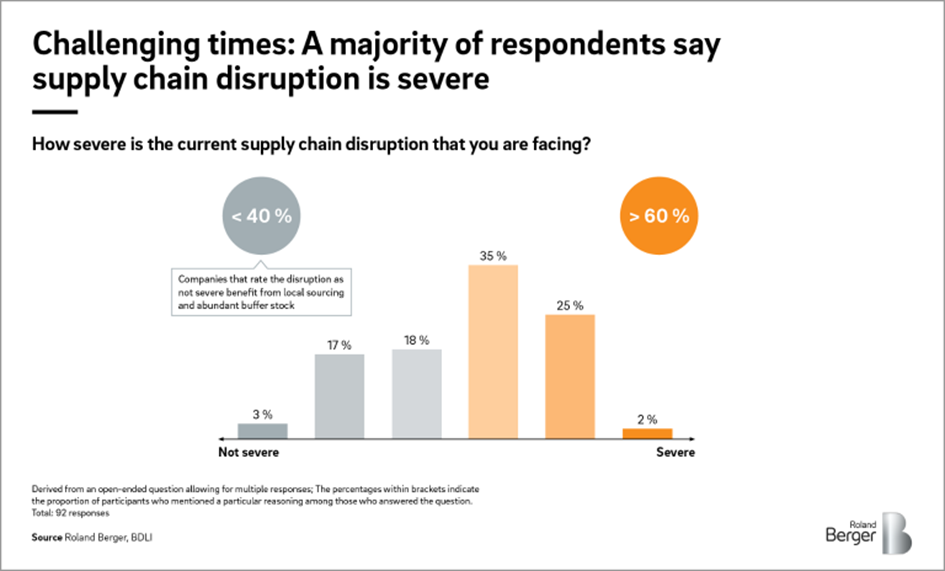
Some industry players are making strides toward resilient supply chains by strengthening their supply chain organizations, risk management, and supplier data integration. Collaboration and openness between OEMs, suppliers, and customers are crucial for building transparency and trust.
Sources:
Aligning Business Goals with Digital Supply Chain Strategies
Sunil Kardam, Head of Analytics at Gramener, emphasizes that a mismatch between business goals and digital strategy often leads to failed supply chain digital transformation initiatives. According to Deloitte, 70% of digital transformations fail, and even successful organizations may take years to compete effectively in the digital market. Kardam highlights the importance of identifying specific challenges and involving stakeholders from various departments to enhance efficiency.
For instance, if a company aims to reduce inventory costs, investing in a real-time tracking platform might not be effective. While it offers real-time shipment insights, it does not reduce inventory expenses.
He further explains the importance of data strategy in digital transformation. For instance, a logistics company aiming to enhance supply chain visibility by implementing a real-time tracking system must collect data from different suppliers and carriers. However, inconsistencies during data extraction can lead to inaccurate shipment information, resulting in delivery delays and customer complaints. This situation is common because 70% of companies lack a proper data strategy, making it difficult to access real-time data and ensure accuracy.
Kardam stresses the need for supply chain companies to establish standards and principles for collecting, managing, and analyzing information to ensure successful digital transformation initiatives.
Another significant innovation is the use of generative AI, which offers deeper assistance beyond chat services, providing meaningful analysis. IBM notes that many supply chains are siloed and struggle with end-to-end execution. Applications and data are often trapped within departmental boundaries, and multiple ERP instances create fragmentation of orders and commitments across disparate systems.
IBM has embraced a hybrid cloud, component-based architecture built on open technologies, enabling the ingestion of high volumes of data at speed and contextualizing them to each persona. This allows the "machine" to learn, think, and execute repetitive tasks while enabling supply chain professionals to focus on high-impact business events.
A question from a supply chain manager ("Where do I have excess inventory?") or a buyer ("How is my vendor performing?") becomes a simple query rather than a complex exercise in compiling disparate reports.
In another article, SCMR highlights several emerging software trends, including generative AI, which is considered a game-changer for supply chain management. Companies seek software that drives decision alignment, and there is high demand for risk evaluation software that allows companies to run simulations. Other notable trends include the continued dominance of cloud solutions in the SCM space and the increasing use of labor management systems as more than just employee monitoring tools.
Sources:
The Debate Over Supply Chain Transparency and Sustainability
At NIKE’s annual shareholder meeting on September 12, shareholders rejected a proposal to assess the effectiveness of its supply chain due diligence efforts. The proposal, brought by Tulipshare, recommended a report on metrics and methodologies used to evaluate risks like forced labor and wage theft. Despite Nike’s compliance with only six of seventeen Sustainable Development Goals under the UN Global Compact, shareholders deemed the proposal unnecessary, citing Nike’s commitment to ethical practices.
Samuel Collins-Charles, Tulipshare’s communications manager, cited Nike’s compliance with only six of seventeen Sustainable Development Goals under the UN Global Compact and its alleged violation of OECD guidelines in its treatment of Cambodian and Thai garment workers.

This decision comes as consumers increasingly prioritize ethical and sustainable products. The 2023 Fairtrade America Consumer Insights report reveals a 61% recognition rate for the Fairtrade label among Americans, up 20% since 2021. Trust in the Fairtrade label has grown, with 85% of US shoppers believing it positively influences their perception of a brand. Products like Fairtrade-certified coffee and chocolate see significant consumer willingness to pay a premium.
To conclude this chapter, we can take a look at a last example. Unlike Nike, some companies are providing full transparency and financial incentives for sustainable practices. Portuguese conglomerate SONAE was recognized for its sustainable supply chain finance (SCF) program, which rewards suppliers with strong ESG ratings with preferential invoice payment conditions. This program has integrated around €170 million worth of supply chain purchases, offering cost reductions for suppliers demonstrating excellent ESG practices.
Sonae is a multinational company managing a diversified portfolio of businesses, including food, electronics, and fashion retail. As part of its goal to achieve carbon neutrality by 2040, Sonae launched a sustainable supply chain finance (SCF) program in 2022.
Sources:
Bibliography
Amazon launches supply chain services for stores, Investopedia - Publication date not retrieved
Amazon's Supply Chain as a Service, Marketplace Pulse - 13th September, 2023
Resilience in aerospace supply chains: Why transparency is the key, Roland Berger - Publication date not retrieved
Poor tech strategy undermining supply chain transformation, Supply Chain Digital - Publication date not retrieved
How Generative AI is Revolutionizing Supply Chain Operations, IBM - Publication date not retrieved
Six emerging supply chain software trends to watch, SCMR - Publication date not retrieved
Nike Shareholders Reject Assessment of Supply Chain Due Diligence, Just-Style - Publication date not retrieved
Fairtrade US Consumers Prioritise Supply Chain Transparency, Sustainability Magazine - Publication date not retrieved
Supply Chain Initiative of the Year EMEA - Sonae, Environmental Finance - Publication date not retrieved


Comments