
Bessent's Buyback Was Supposed to Calm Yields. It Didn't.
The Treasury doubled its bond buybacks this week to bring long-term yields down. Instead, the market read the move as a signal of looser policy ahead and priced in more inflation, sending the 30-year Treasury to its highest level since 2007, the same week the Fed's own minutes showed three sitting officials voting to raise rates.
What a Treasury Buyback Actually Does
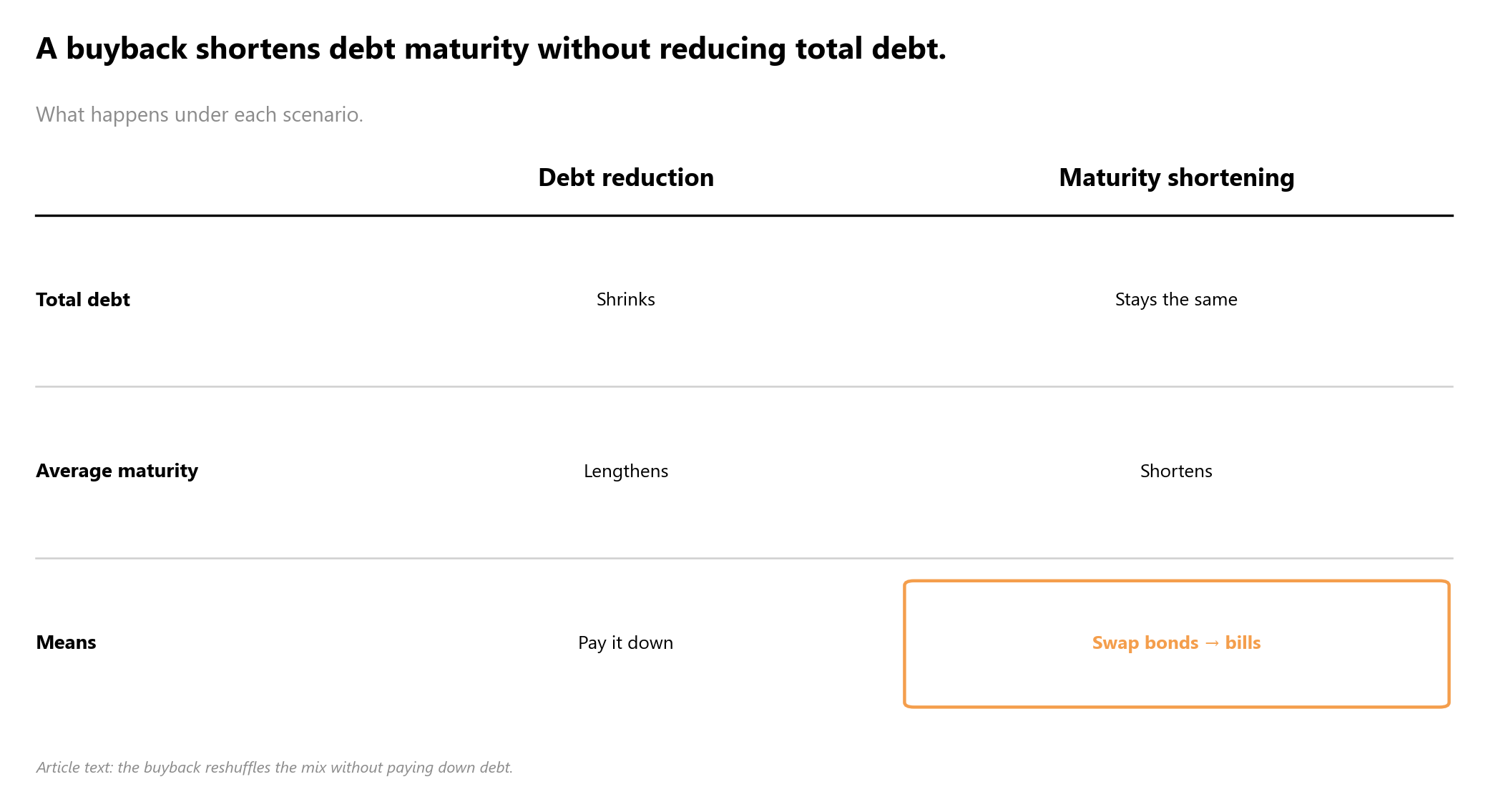
When the Treasury Department buys back its own bonds, it is not paying down the national debt. It is reshuffling the mix. A buyback of long-dated securities, funded by issuing more short-term bills to cover the cost, shortens the average maturity of the debt outstanding without shrinking the total by a dollar. The government still owes the same amount. It just owes more of it sooner.
Long-term yields have been climbing for weeks. As we covered in our August 9 piece on stagflation-lite dynamics, a weak July jobs report and an oil shock from the Middle East conflict had already pushed the 30-year Treasury toward levels not seen since before the 2008 financial crisis. That backdrop is not the news this week. The news is that Treasury Secretary Scott Bessent decided to actively intervene against it.
On Wednesday, August 19, Treasury announced it would at least double its routine buyback of longer-dated government debt, from about $2 billion to more than $4 billion per issue. Bessent, who calls himself the nation's top bond salesman according to the newsletter Net Interest, told CNBC the next day that the number could grow further. "We're going to increase the size of the buyback," he said. "I would note that it could be more than the 4 billion per issue." He described liquidity for the 30-year bond as very poor, and said Treasury wanted "people to focus on the fundamentals and not trade the headlines during a quiet period in a thin market."
Why the Market Read It as Inflation, Not Relief
Markets have a direct way to measure inflation expectations: the breakeven rate, which compares a Treasury bond's yield to that of an inflation protected security of the same maturity, per CNBC's reporting on the episode. A rising breakeven means investors are demanding more compensation for future inflation, not less.
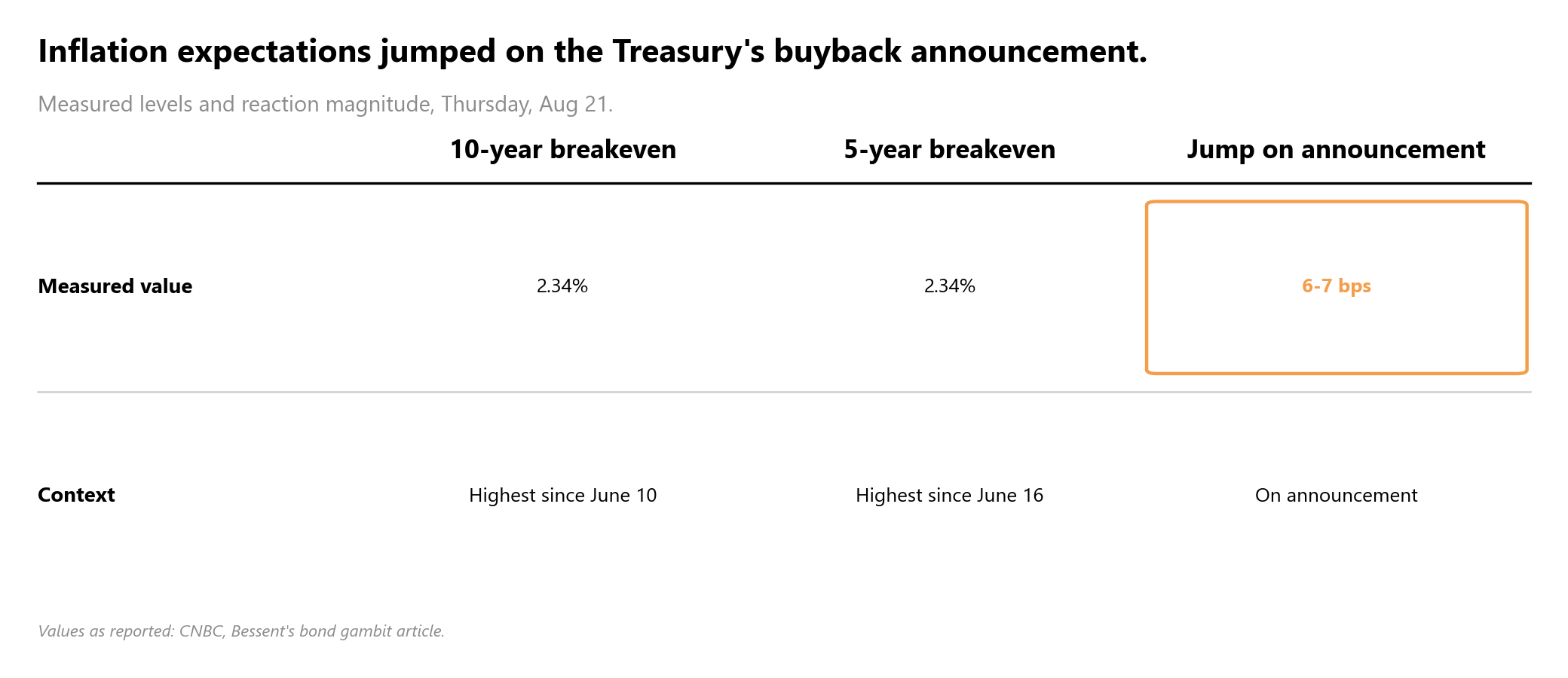
That is exactly what happened after Wednesday's announcement. The 10-year breakeven rose to 2.34% on Thursday, its highest level since June 10, and the 5-year breakeven hit the same mark, its highest since June 16, CNBC reported. Macquarie's Thierry Wizman noted the 10-year breakeven jumped about 6 to 7 basis points on the announcement alone, a move he called "not insignificant." Long-dated yields, which fell sharply on the day of the announcement, had fully reversed by Friday. The 30-year climbed to 5.27%, the 10-year to 4.73%, both above where they stood before Treasury acted.
The rest of the market moved the way it does when investors start pricing in looser money rather than a liquidity fix. Bitcoin opened Friday at $73,013, up 5.4% from Thursday, and had climbed to $77,307.95 by mid-morning, a rally Yahoo Finance tied directly to the Treasury announcement. Gold futures opened at $4,577 an ounce, up 5.9% for the week and 36.7% for the year, with Yahoo Finance citing the record national debt and debasement concerns as the driver. The dollar, meanwhile, lost close to 0.9% over the week. BlackRock CEO Larry Fink had made a related argument months earlier, telling the Milken Institute conference in May that holding cash in a bank account is "one of the worst financial decisions of a lifetime." His comment predates this week's news, but it captures the same instinct now showing up in gold and bitcoin prices: get out of dollars and dollar adjacent assets.
A Week of Numbers That Made the Intervention Harder to Sell
The intervention followed a rough stretch at the auction block. A $42 billion sale of the 10-year note on August 12 priced at a yield of 4.683%, the highest since 2007, according to Net Interest. A $25 billion sale of the 30-year bond the next day priced at 5.216%, the highest since 2001. Investors still showed up, bidding for about 2.5 times the debt on offer, but they demanded a higher return to do it.
The fiscal backdrop makes that price demand easier to understand. The national debt crossed $40 trillion on August 18, CNBC reported, after a July deficit of $432.3 billion, the highest monthly shortfall since March 2021, with interest on the debt already totaling nearly $1.2 trillion for the year, the largest budget line outside Social Security and Medicare.
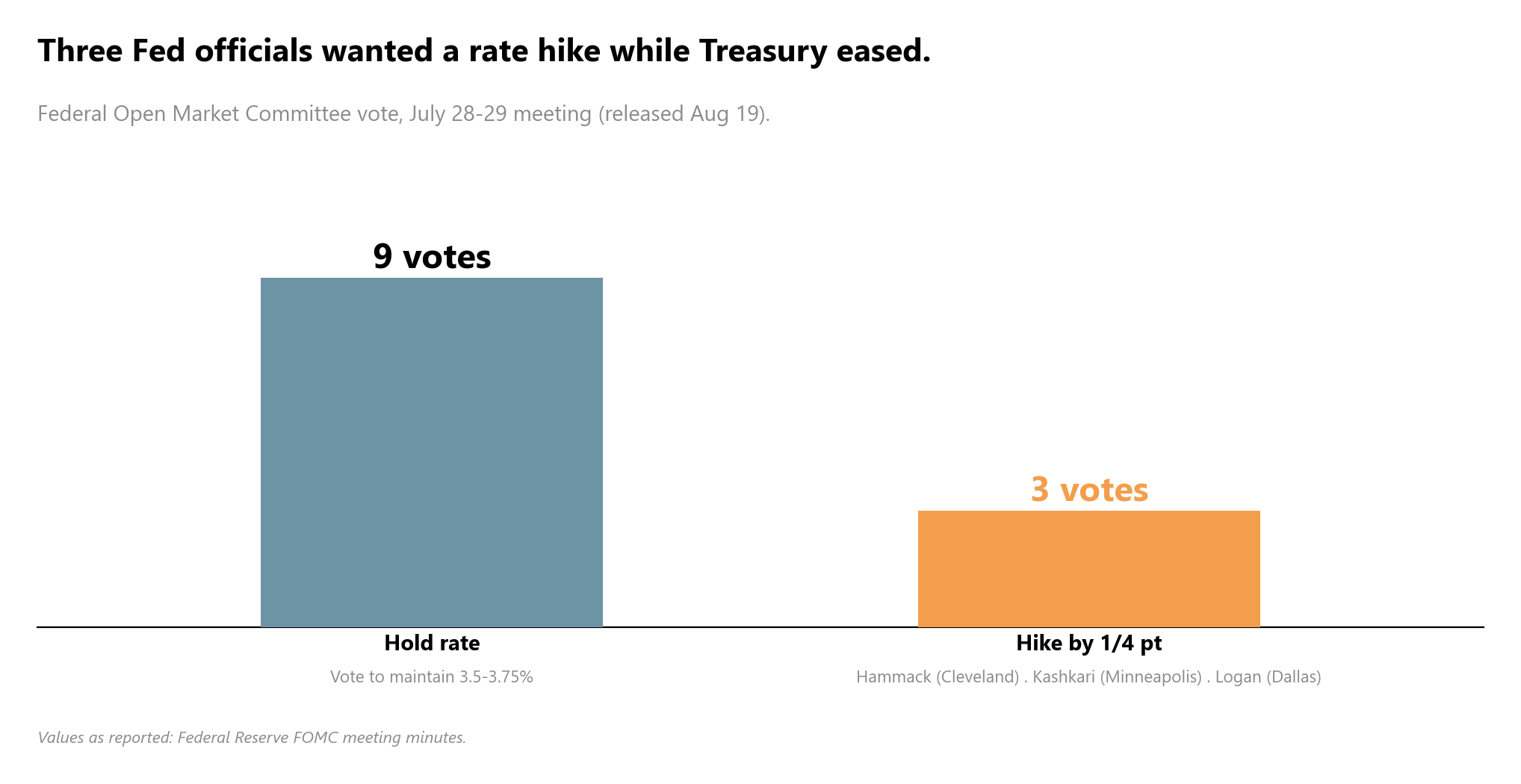
The same week delivered a monetary counterpoint. Minutes from the Federal Open Market Committee's July 28 to 29 meeting, released August 19, showed the Committee voted 9 to 3 to hold the federal funds rate at 3.5% to 3.75%. Three regional Fed presidents dissented in favor of a quarter point hike: Beth Hammack of Cleveland, Neel Kashkari of Minneapolis, and Lorie Logan of Dallas, per CNBC's separate reporting on the minutes. The minutes themselves record the vote in full. "Voting against this action: Beth M. Hammack, Neel Kashkari, and Lorie K. Logan, who preferred to raise the target range for the federal funds rate by 1/4 percentage point at this meeting." Treasury was easing its grip on long-term yields in the same week that three sitting Fed officials wanted to tighten policy.
AI infrastructure spending is one more claimant on the same pool of long-term savings, though not the main story here. Hyperscalers have already sold almost $500 billion in bonds this year to fund data center buildouts, and are likely to borrow at least $300 billion more before year end, according to Goldman Sachs figures cited by economist Mohamed El-Erian. That issuance competes directly with Treasury for buyers of long-dated debt, alongside higher yields now on offer from sovereigns like Japan. It is a contributing pressure, not the reason yields are where they are.
What Homeowners Felt, and Who's Right About How Bad This Is
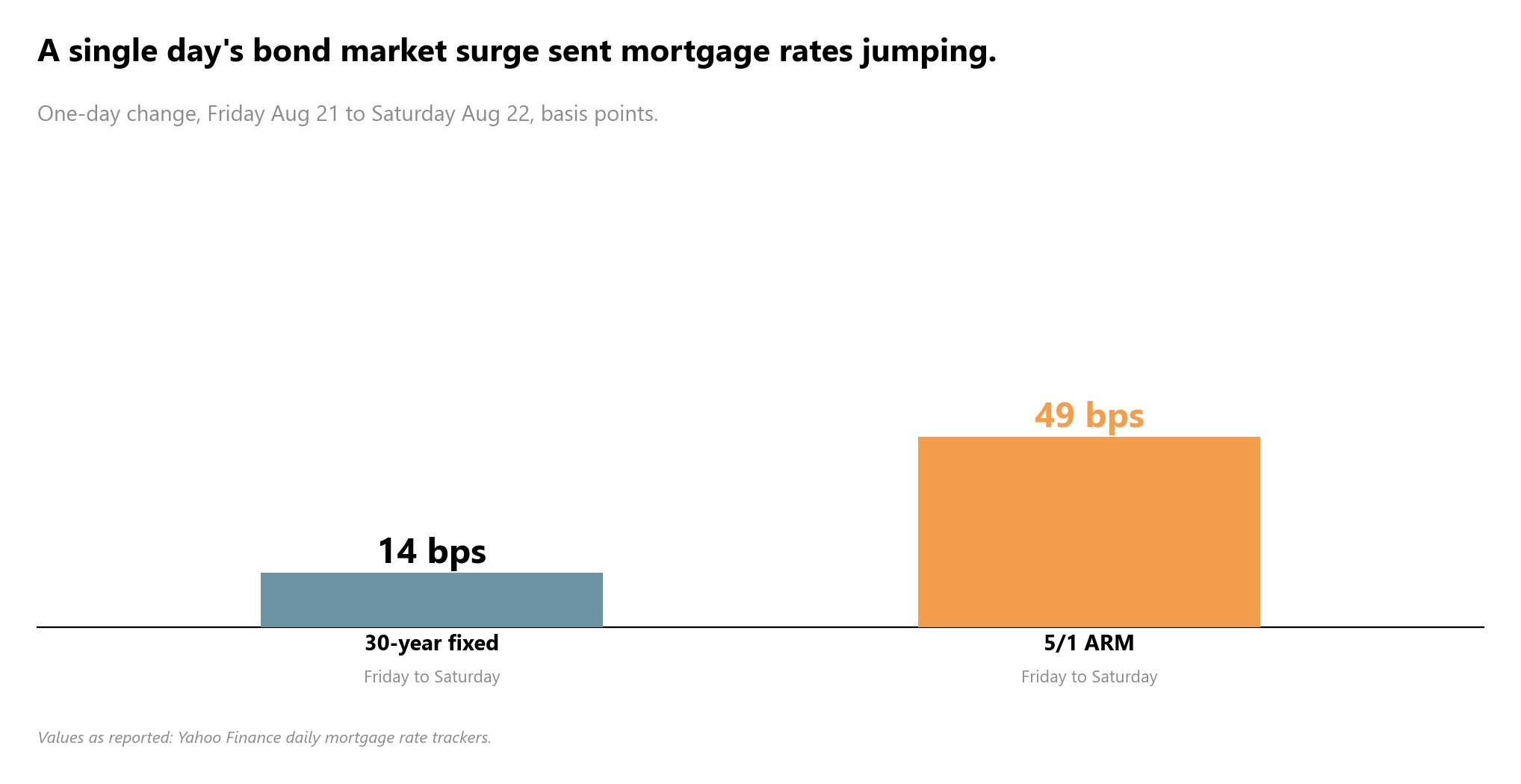
Bond yields do not stay confined to Wall Street. Mortgage rates track the 10-year Treasury closely, and this week they moved with it. The average 30-year fixed rate stood at 6.50% on Friday, August 21, down slightly from Thursday, according to Yahoo Finance's daily tracking of Zillow data. By Saturday it had jumped 14 basis points to 6.64%. The 5/1 adjustable rate mortgage swung even harder, from 6.25% on Friday to 6.74% on Saturday, a 49 basis point move in a single day. Earlier in the week, CNBC had already reported the average 30-year mortgage pushed as high as 6.75%, as the spread between 2-year and 10-year Treasuries widened by nearly 29 basis points since late June.
Economists do not agree on how alarmed to be. Mohamed El-Erian, the former PIMCO chief executive, wrote that this is "no ordinary bond-market sell-off" and warned it could be the start of "a structural economic shift more enduring and more globally consequential than most previous episodes of market volatility." Noah Smith, writing at Noahpinion, argued the opposite. Measured against the sharp rate increases of 2021 to 2023, he wrote, the current move is only a few tenths of a percent, small enough that a true sovereign debt crisis probably has not begun. Bessent himself took a third position entirely. "There's nothing magic about the 40 trillion number," he told CNBC, adding there is a "very good chance" the deficit under President Trump has already peaked and that the country can "grow our way out of that."
CNBC's own reporting split the difference, and not in Bessent's favor. It described his two pronged approach, bigger buybacks paired with public reassurance, as having "met with little success."
What It Means
The clearest reading of this week is that Bessent has a credibility problem, not a funding capacity problem. The same week Treasury struggled to hold down its own yields, the World Bank priced a $4 billion, 7-year dollar bond at a spread of just 3.9 basis points over Treasuries, drawing more than $11 billion in orders from over 150 investors, banks, central banks, and asset managers among them. Dollar denominated debt from a top rated borrower is not hard to sell right now. What is hard to sell is more of what Treasury itself is issuing, at the price Treasury wants to pay for it.
Part of that is self-inflicted. Jefferies' chief U.S. economist Thomas Simons pointed out that the buyback announcement broke with Treasury's own practice of saving policy changes for its quarterly refunding announcements, a shift he said "reduces the overall credibility of their guidance." By Thursday, the economics blog Econbrowser noted, 10-year yields were already back near where they stood before Wednesday's announcement, prompting the dry observation that the self-described king of debt had not managed to tell the market what to do.
Two things are worth watching next. Fed Chair Kevin Warsh delivers his keynote at the Jackson Hole symposium on August 28, and how dovish he sounds will move the same breakevens that jumped this week, in one direction or the other. The mortgage market, a topic worth tracking closely in its own right now, will show whether Saturday's jump was noise or the start of a longer freeze. The Bipartisan Policy Center already estimates that war costs and reversed tariff refunds are adding roughly $250 billion to this year's deficit beyond the Congressional Budget Office's original projection, a trajectory that sits uneasily next to Bessent's claim that the worst is behind him.


Comments