
Lagarde Calls AI Financing 'Serious Competition for Sovereign Debt'
On September 12, European Central Bank President Christine Lagarde told the regional French newspaper Ouest-France that AI-related financing needs are competing with governments for capital, part of why long-term borrowing costs keep rising. No other source reviewed for this article repeats that explanation: the three that mention Lagarde and AI together are all ECB primary sources themselves. This blog has covered the rise in long-term rates three times this year without hearing it anywhere else.
What Actually Sets the Price of Government Debt
On September 10, the ECB's Governing Council raised its three key interest rates by 25 basis points, taking the deposit facility to 2.50 percent, the main refinancing rate to 2.65 percent and the marginal lending rate to 2.90 percent, effective September 16. The Governing Council pointed to the Middle East conflict as the source of an inflation shock it now expects to last longer than assumed in June.
That decision sets the ECB's own policy rate. It says nothing about what governments actually pay to borrow for ten, twenty or thirty years, a price investors set, not central banks. Longer-term borrowing costs move with what economists call the term premium, the extra yield investors demand to hold a bond for years instead of rolling over something shorter. A rise in that premium can reflect the sheer amount of new government debt investors are asked to absorb, or other borrowers, companies, private funds, any issuer, competing for the same capital and pushing prices up for everyone. Keeping the two apart is the point here.
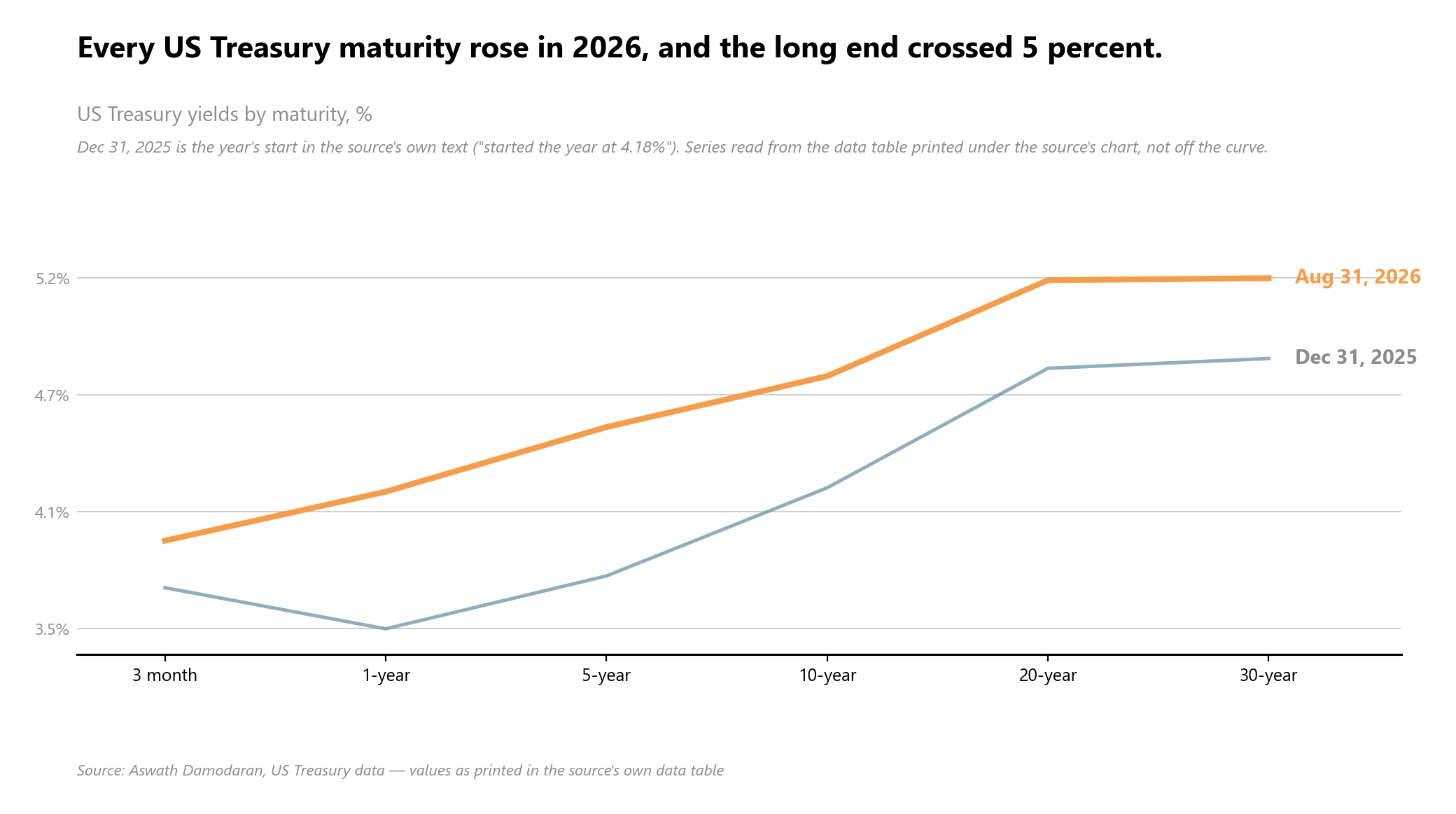
The scale of the recent move makes the distinction worth making. Aswath Damodaran, the NYU finance professor who tracks these numbers every year, calculates that the 10-year US Treasury yield rose from 4.18 percent on January 1 to 4.75 percent by August 31. Both the 20-year and 30-year yields crossed 5 percent, and US federal debt passed 40 trillion dollars for the first time.
Not every borrower carries that move the same way. Torsten Slok, chief economist at Apollo, notes that US corporate net interest payments have fallen to 0.4 percent of GDP as companies locked in fixed low rates during the pandemic. The federal government now pays 3.6 percent, because the Treasury never extended its own debt's maturity when rates were near zero. Corporate America refinanced cheaply while it could; the government's bill is exposed just as a new category of borrower shows up.
Lagarde Names a Fourth Explanation
At the press conference two days before the Ouest-France interview, a reporter asked Lagarde about the global rise in bond yields. Her answer named AI as a factor for what appears to be the first time among the sources reviewed for this article. She said: "When you have significant financing needs arising out of, I will not say hyperscalers, because I think that is actually narrowing the economic sector that is concerned, any AI-related activity at the moment is a potential consumer of financing. And whatever form it takes: it used to be restricted to equity, it's moving now clearly to bonds, in the private credit area as well."
Two days later, in Ouest-France, she put the same idea more plainly, to a different audience, when asked whether rising borrowing costs should worry French readers: "The rise in long-term rates is linked to two factors. The first is the state of public finances in general, and in the United States in particular. The second is the funding needs of economic actors, especially for artificial intelligence, which represent serious competition for sovereign debt: when investors can choose between different issuers, this inevitably drives up costs for those issuers."
Lagarde's account is the crowding-out story, stated by an issuer instead of inferred from outside. This blog's earlier pieces treated the sovereign safety premium as something that had simply gotten more expensive to produce, and treated GPUs as collateral, without ever connecting AI capital demand to the price government pays for its own debt. Lagarde's answer is the missing link. It arrived in a regional daily the same day she addressed the Fête de la Pomme in Normandy in a separate ECB speech, not in a wire story a bond desk would flag.
The same pull shows up well below sovereign yields. Researching home AI setups, I watched a video, posted only a few months earlier, of someone building a nearly 100-gigabyte VRAM rig from used Intel B60 cards the presenter priced at around 500 dollars each. Checking eBay for the same cards turned up nothing under 800 dollars, a jump of roughly 50 percent that made building one at home a little less accessible. Afterward the plan became trying something cheaper instead, since the goal was still experimentation, not an infrastructure investment.
What the Sources Show
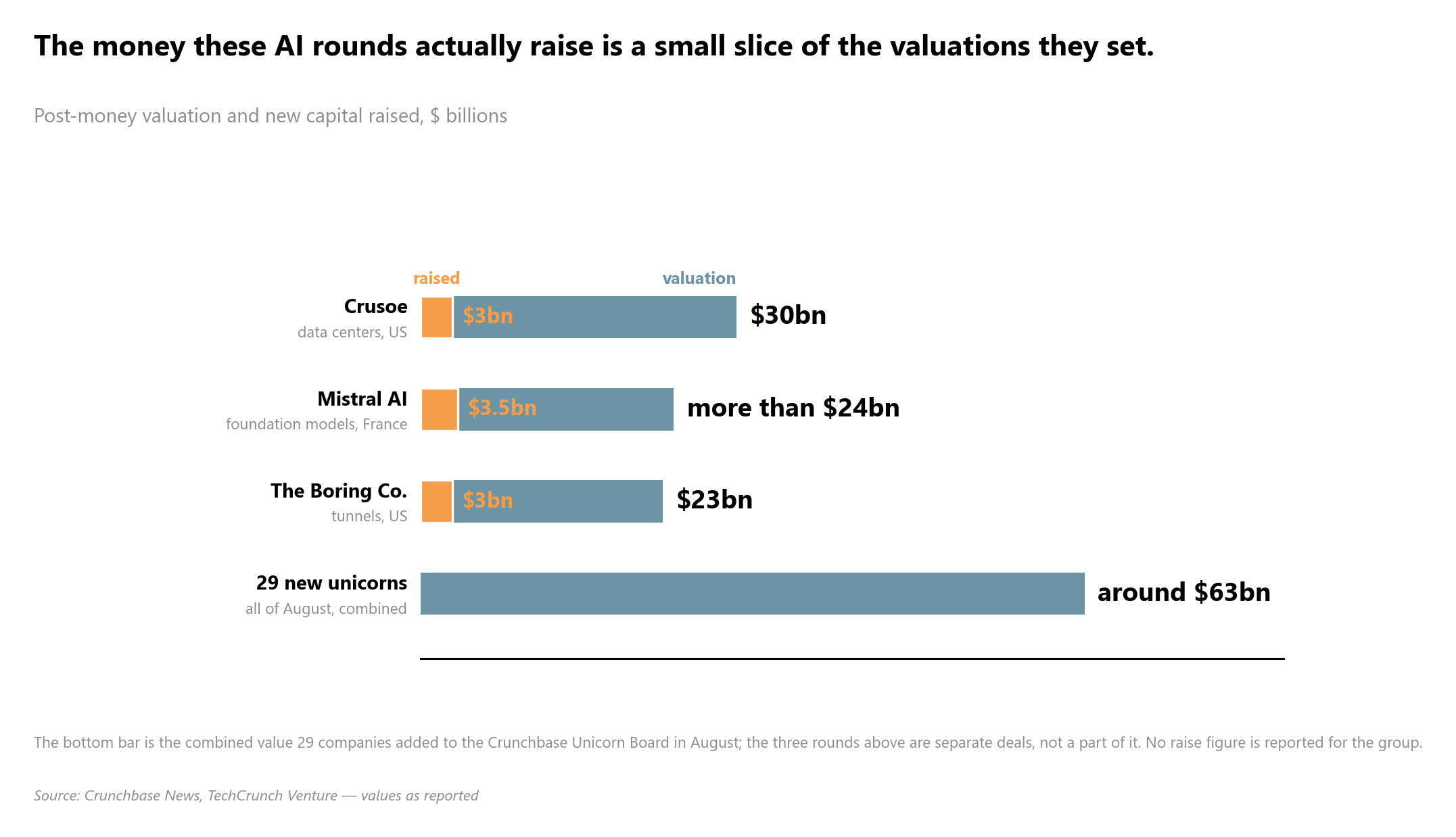
AI-linked capital demand in this window is not hard to find. Crunchbase counted 29 companies reaching billion-dollar valuations in August alone, adding roughly 63 billion dollars in combined value. In the same weeks, Crusoe raised 3 billion dollars at a 30 billion dollar valuation, Paris-based Mistral AI raised 3.5 billion at a valuation above 24 billion, and Boring Co. raised 3 billion at 23 billion. These are self-reported figures, not audited measurements: they show the size of demand for capital, not how much of it competes with government bonds for the same investors.
What the sources reviewed for this article do and do not contain against Lagarde's claim deserves precision. One Econbrowser post, by economist Menzie Chinn, engages a nearby argument: former CEA chair Stephen Miran's claim that an incipient growth boom explains today's high real rates. Chinn's own text does no more than pose the question, against a chart from Hamilton, Harris, Hatzius and West. His words: "If you see a clear positive association between growth and the real interest rate, then you have better eyes than I do." That is a doubt about a growth-boom story, not a rebuttal of Lagarde's crowding-out story. None of the sources reviewed here name an economist directly disputing the mechanism Lagarde describes.
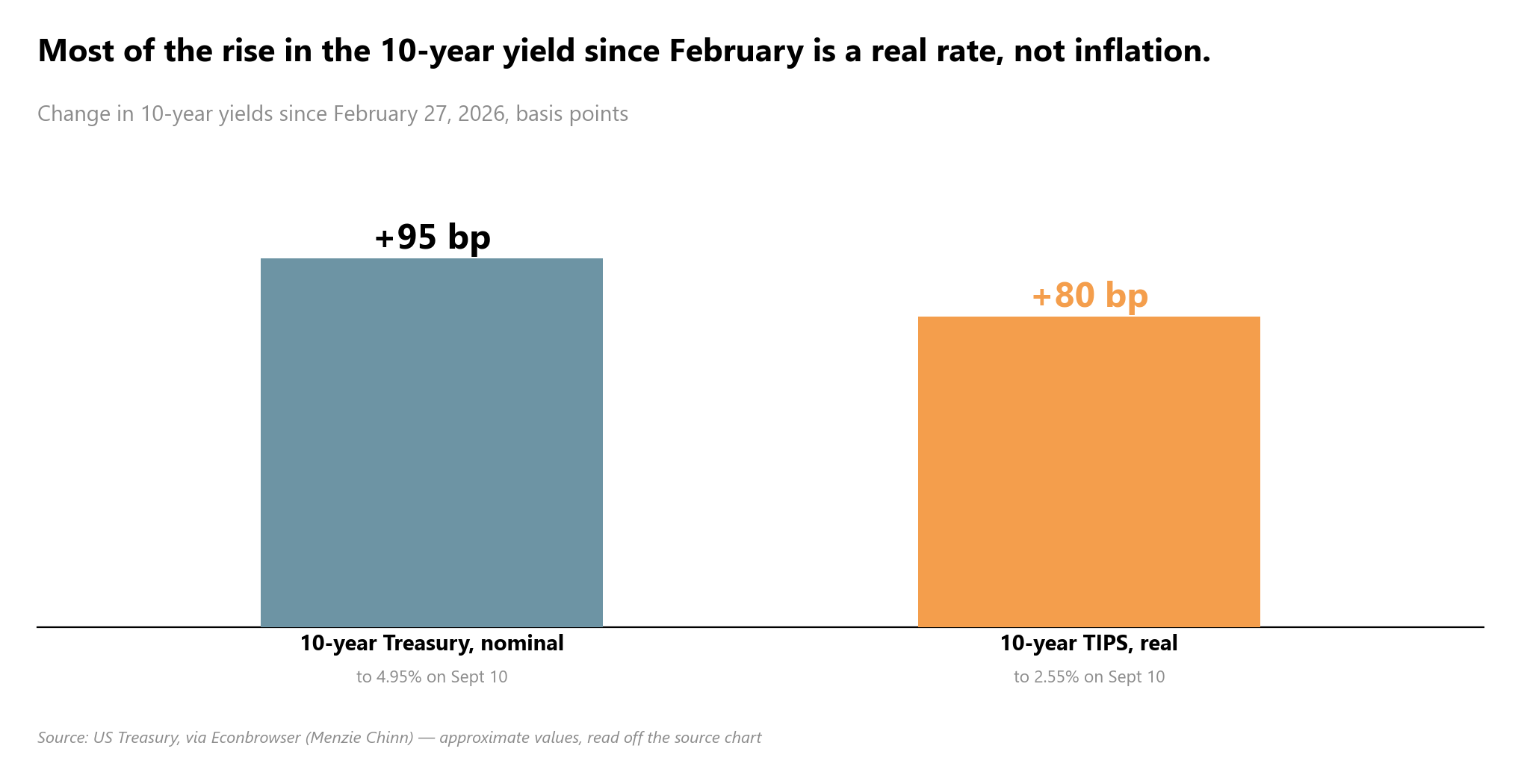
Chinn's own chart, sourced from the Treasury, tracks the change in 10-year nominal and TIPS (inflation-protected) yields since February 27. Read from the chart, values approximate: by September 10 the nominal yield had risen roughly 95 basis points to 4.95 percent, the real TIPS yield roughly 80 basis points to 2.55 percent. Most of the increase is a rise in the real rate, consistent with competition for capital, though it does not prove Lagarde's version over any other real-rate explanation.
I still pay by subscription, not API usage, but I am using more and more digital services across my different projects, and that is what is pushing my bill up. It runs around 150 euros a month now, a small version of the pull on spending the Crunchbase numbers show at scale.
The Circularity Lagarde Is Also Naming
Asked about ECB staff warnings of a hypothetical AI-driven US stock market correction, Lagarde said AI-sector valuations are "very high" and pointed to planned IPOs as evidence. She also named a specific risk: "circularity risk, whereby one company acquires a stake in another, which then awards it a contract to supply microchips, etc." European banks hold AI-related assets, though the financial sector remains far stronger than in 2008 or 2011.
Two items from the same window show the interlocking arrangement she is describing, without calling it a bubble. On September 10, Palantir and Nvidia announced a combined sovereign AI architecture, pairing Nvidia's Nemotron open models with Palantir's Foundry and AIP. The first deployment sits inside Nvidia's own supply chain; Nemotron itself extends Nvidia beyond chips and into the model layer. Separately, SpaceX's chief financial officer told investors the company is expanding terrestrial AI compute capacity from just over 2 gigawatts to 5 to 10 gigawatts next year.
It is interesting that they would admit it, I think. Why would they admit it? They do not admit inflation, they do not admit labor market is bad. Do they have an interest in us believing a correction is coming? Are they trying to slow the bubble down for a smooth landing, or gatekeep normal citizens from investing, or make it more volatile? It may be part of a narrative they are building so that when things go wrong they can blame AI, bundling a few other problems with it.
What It Means
Lagarde's phrase, funding needs of economic actors, in particular for artificial intelligence, describes where capital demand comes from without saying where the money lands. Fresh financing reaches a small number of well-positioned firms first; prices for everyone else, from GPUs to government bonds, adjust around them afterward. Most of the largest rounds named above went to US-based companies, not European ones.
Lagarde's phrase reminds me of the Cantillon effect: fresh money goes straight into the pockets of a few, while making things worse for everyone else. We are already seeing tech inflation because of AI, and financing on this scale would only make that worse. It is a price to pay to be competitive, and Europeans are already paying for US tech financing anyway, so why not benefit EU companies instead? The worst outcome is the money going straight to American companies, increasing EU dependency on American tech even further.
Lagarde doing some narrative preparation can be surprising, yes, but not shocking to me. It makes me wonder what they think, since they absolutely do not benefit from the AI boom and so have less reason to let things get out of hand, unlike the US.
Nothing about this explanation has been tested by wide repetition yet. It surfaced in a regional interview, the same day as an unrelated Fête de la Pomme speech in Normandy, not a statement built for the wire services, and as of this writing no major outlet, among the sources reviewed for this article, has picked it up. Whether Lagarde repeats the line at the next press conference or lets it quietly drop will say as much as the line itself did.


Comments